The Illustrious Odyssey of the Hoyt "High Estate" Family
The history of the Hoyt-Hayte, Haute de Hautesbourne, and Hauteville families is one filled with adventure, nobility, and a significant impact on the course of Western history, culture, and philosophy. Originating from Normandy and Lorraine to Kent, Somerset, and the Founding of New England America, their ancient lineage is intertwined with influential figures such as William the Conqueror, Holy Roman Emperor Henry IV, Queen Elizabeth Wydville, Queen Elizabeth of York, and King Henry VIII. Their ancient endeavors ranged from the establishment of the first Crusades to the promotion of Christianity in England, the construction of grand cathedrals, and their eventual involvement in the Puritan exodus to the New England colony. This article delves into the remarkable journey of these people, highlighting their archaic legacy and contributions to the world of England, France, Europe, and America.

William Tecumseh Sherman-Hoyt Monument - Adobe Stock
I proudly trace my lineage back to the esteemed Hoyt family of America, a family with a rich history woven into the foundations of the United States Constitution. Our ancestral legacy can be traced from the influential Fundamental Orders of Connecticut, which laid the groundwork for modern democratic governance, to the pivotal role our family played as abolitionist protagonists in Wisconsin, vanguards of the Lincoln republic. The governing line of Hoyt includes notable family members: Henry Martyn Hoyt, Governor of Pennsylvania, John Wesley Hoyt, Governor of Wyoming Territory, John Philo Hoyt, Governor of Arizona Territory, William Tecumseh Sherman-Hoyt General of the Army, Senator John H. Sherman-Hoyt Principal Author of Sherman Antitrust Act of 1890, and their ascendant progenitor founding father & deacon in Thomas Hooker’s church, Simon Hoyt. Today, the Hoyt family continues to uphold the principles of liberty, justice, and progress, contributing to the ongoing evolution of the modern democratic republic we call home.
Like the Puritan families described in Hawthorne’s The House of the Seven Gables, this early American lineage is held with the weight of an earldom, their expansive lands and civic authority giving them the posture of nobility. Yet the settlers themselves represent a contrasting model, where influence arises from altruistic participation in the formation of law and community, an idea captured in the words of Richard Overton: “Every man by nature being a king, priest and prophet in his own natural circuit and compass, whereof no second may partake but by deputation, commission, and free consent from him whose natural right and freedom it is.”
The Hoyt family is listed among the Prominent Names of New York 1898, recognized alongside the same pages as Astor, Bell, Carnegie, Cromwell, and Vanderbilt. A legacy woven into the fabric of America; their marquee name of liberty is etched on city street signs across the nation. In Fond du Lac, Wisconsin, the birthplace of magnate Edward Doheny and an original cadet settlement of the Hoyt family, he may have looked up at the Hoyt name on a street sign long before his own name shone on one of Beverly Hills’ great thoroughfares.
Regardless of nomenclature, isopoints of archaic heritage demonstrate how families are still related. Through the historical practice of changing surnames due to marriage, adoption and other societal pressures, many families have maintained a consistent naming pattern across generations. Isopoints connect parents and their children, as well as extended family members, through a common surname that has been shared since ancient times. This helps to ensure that families maintain a deep connection with their ancestors and have knowledge of their heritage including how their family name has evolved. As time passes, these common ancestors continue to serve as a testament to these enduring relationships. This Abrahamic tradition of tracing lineage has been repeated time immemorial from our contemporaries to Charlemagne and Carloman to Messianic Davidic ancestry.
The De Hauteville family traces its roots to the same Normandy & England regions as the traversing ancient noble family, De Haute (aka Fitz Haute) of Metz Lorraine during the time of Holy Roman Emperor Henry IV and William the Conqueror, who established themselves in England. The forebear of the legendary De Hautes (Gerard de Lorraine) was purportedly captured and released by the De Hautevilles. It has been said they trace their lineage to Gerard III de Lorraine Fitz Haute, Gerard de Lorraine, Gerard Girardis de Paris, Carloman, Pepin the Short, Saint Martel, and Senator Tonantius Ferreolus, Narbonne and Rome. The donation of Pepin provided the legal basis for the creation of the Papal States.
Led by Robert Guiscard and his brother Roger, the De Hauteville family of Normandy rose to prominence during the 11th century. These ambitious brothers embarked on a conquest that would shape the destiny of Europe. Meanwhile, the Norman Conquest of England in 1066 marked a significant apex for the De Haute family. William the Conqueror, who was of Norman origin, sought to further Christendom in England. The De Haute family arrived during this time and participated in the establishment of monasteries and cathedrals across the country, that includes andvancing the illustrious Canterbury Cathedral. The De Hauteville brothers played a pivotal role in the First Crusades, launched in 1095. Their military prowess and strategic brilliance were instrumental in the success of the Crusaders. The De Hautevilles, alongside other noble families, led campaigns not only in the Levant but also in territories including England and Sicily.
The Plantagenet Anjou kings of England ruled through dynastic succession and feudal monarchy, holding the crown from Henry II through Richard II. Their authority rested on conquest and crown, a lineage tied to Angevin and Norman power. The related Norman house of Hauteville, which carved out dominions in Sicily and southern Italy, is best aligned with this Plantagenet–Anjou tradition. By contrast, the Lotharingian Ardennes Metz tradition carried the older Carolingian and Holy Roman Imperial inheritance, where the Haute family of Kent drew its identity as custodians of law, covenant, and stewardship rather than sovereign rule.
Kent and Dover were never besieged by William the Conqueror, with their people receiving gavelkind preservation of rights. This land became the settlement of the De Haute family lineage. Their county motto is “Invicta,” meaning “undefeated.”
According to Thomas of Chillenden’s Register (1396–1455), the earliest surviving record of testaments kept by the Commissary-General of Canterbury, the Haute family is clearly represented. By the fifteenth century, multiple branches of the family had already emerged, indicating a well-established and expanding lineage.
A substantial collection of Haute deeds, preserved in the British Museum, further demonstrates the extent of their holdings. These records show that the family possessed considerable property in the heart of Kent, as well as lands in Somerset (also Buckinghamshire, Sussex, and London). The distribution of these holdings suggests origins in the Norman settlement of England, with later development occurring alongside the broader ecclesiastical and landholding frameworks that characterized the medieval period, including those associated with monastic and military orders, such as the Templar Knights.
Names such as Symon Haut (c.1244) appear across generations, reflecting continuity in naming traditions that can also be observed in later associated families, such as by the American progenitor Simon Hoyt (c.1629). While separated by approximately four centuries, these parallels contribute to a broader inherited identity and lineage memory carried through name and tradition. Simon, the name symbolic of a living stone, represents a foundation of the corporate building of the spiritual house. Simon Peter (Shimon bar Yonah) founder of the First Church, Symon Haut a founder of England’s Church, and Simon Hoyt founder of the Anglican Puritan Congregationalist Church, each a monument from which schisms, language, and entire belief systems are supported.
The name De Haute carries an entendre of təˈħawt—the sacred syllable of Thoth, god of wisdom, measure, and divine order extending from the Great Pyramid Temple of Thoth. invoking a legacy not merely of a patrician nobility, but of temple and church builders through the ages.
Their role hints at a deeper charge: stewards of the unseen blueprint, where sacred geometry shaped both cathedral stone and inner discipline. In such families, the temple persisted, not just as structure, but as duty, code, and rite. From ancient priesthoods to monastic knighthood and onward to the Enlightenment lodges of Masonry, the work continued: building not with tools alone, but with ethics, wisdom, and measured thought. The temple, in every age, was both external and internal.
The name De Hawt also aligns phonetically with תחות (T’ḥut), the modern Hebrew rendering of Thoth. Though not found in Biblical texts, תחות is linguistically sound and symbolically rich. It recalls beneath, foundation, in place of, the celestial scribe. It is a linguistic vessel of Hermetic philosophy, where what lies beneath reflects what is above. Here, the underworld is a vault of radiant order, of height, where divine architecture is mirrored in the soul.
Thoth, as the heart and the tongue of the god, stood as the divine intermediary before whom all trials of truth were weighed. In Egypt, he uttered the word of justice, recorded the measure of the soul, and revealed the will of the divine. Truth was not merely an abstract principle; it was the living word of god, spoken in the land of Hwt-ka-Ptah, the house of the soul of Ptah, where creation itself began through thought and speech. There, beneath the gaze of the eternal temple, the ideal of the master builder emerged—not simply as a worker of stone, but as one aligned with the architecture of the cosmos. In this figure, Thoth foreshadows Hiram Abiff, the Masonic emblem of fidelity, sacrifice, and sacred construction. The order carries this forward, preserving the mysteries of the word, the measure, and the temple as living expressions of moral law and truth.
The Great Pyramid Temple of Thoth signifies the transmutation of material stone into, soul, an etheric light spirit body, enshrined as a unified body of knowledge, and measurement of space time energy. It stands at what has been said to be the center of gravity of the continents, dividing the earth’s landmass into equal quarters. This sacred structure generates a divine, balanced rhythmic oscillation, like a heartbeat in synchronous rhythm with the frequency of the earth to which all life is attuned. It intrinsically connects our human essence and soul to the spirit of this living body of knowledge and truth. As the cornerstone of human ingenuity and the codification of law and order, it embodies a strict pattern of commandments enshrined in the covenant of T’ḥut-Moshe, aligning us with karmic and transcendental entanglement between divine will, emotion, and mind, all held within the spectrum of preponderant gravity and radiance. This sacred knowledge later extended to the Temple Mount and the tabernacle technologies of divine communion.

Normandy - Adobe Stock

Metz Lorraine - Adobe Stock
In the historical context of Kent, prominent figures from the De Haute estate family, Sir William De Haute, nephew to Elizabeth Woodville and cousin to Elizabeth of York, his father William De Haute, MP, and his grandfather Sir Nicholas De Haute, emerged as influential members of parliament, knights, sheriffs, steward to Christ Church Priory, Canterbury, and keepers of Canterbury Castle. Their roles and contributions in Kent were of significant importance. Their ancestor, Sir Henry De Haute, great-grandfather to Nicholas De Haute, a descendant of the Anglo-Normans and Dukes of Lorraine, distinguished himself as a knight in Kent during the medieval era.
The De Haute family, known for their distinguished lineage, enjoyed a close relationship with royalty, often serving as yeoman to the monarchy. Their reputation extended throughout the Kent area, where they were regarded with great respect and influence. In particular, the family's connection to the region was so profound that Bishopsbourne, a village in Kent, came to be known as "Hautesbourne" in recognition of their significant presence and influence. The village itself became a testament to the enduring legacy and impact of the De Haute family in the local community. Their noble heritage, combined with their commitment to duty and service, elevated their standing and solidified their place among the esteemed families of Kent.


Canterbury Cathedral - Adobe Stock
The De Haute family's involvement in positions such as knights, sheriffs, and keepers of Canterbury Castle exemplifies their high social status and the trust placed in them by the local authorities. Their roles not only contributed to the stability and security of Kent but also showcased the family's esteemed position within the region. The efforts of William De Haute and Nicholas De Haute in their various roles left a lasting impact on the history of Kent. Their bravery, leadership, and commitment to their duties helped shape the social and political landscape of the county, leaving behind a legacy of honor and service.
During the Tudor era, which spanned the 16th century, England experienced a surge of nationalism under the reign of King Henry VIII. In the early years of the dynasty, a significant migration of Protestants occurred from Kent to Somerset. This movement was driven by various factors, including religious, economic, and political circumstances. This marked a crucial turning point in English history, as he sought to break away from the authority of the Roman Catholic Church and establish the Church of England. This religious shift caused upheaval and division within the country, leading to the emergence of Protestantism as an alternative to Catholicism.
The 1576–1586 quarrel for the Rochester Cathedral '6th Stall' highlights the Hayte family’s proximity to the Tudor Crown and their mastery of the legal system. After a ten-year dispute in the Court of Common Pleas, marked by accusations of forgery and claims of royal patent alterations by Queen Elizabeth herself, Walter Hayte successfully overturned a rival claim. By 1586, Hayte was formally instated as the rightful successor, proving the family’s ability to navigate the complex intersections of church, law, and royal favor to preserve their ancestral standing.
In Kent, a stronghold of Catholicism, the implementation of religious reforms and the increasing persecution of Protestants under Queen Mary I's reign created an environment of religious intolerance and oppression. Many individuals and families who held Protestant beliefs sought refuge and a chance to freely practice their faith in other parts of the country. Somerset, located in southwestern England, became an attractive destination for these Protestant migrants. The county offered the promise of religious tolerance and a more sympathetic environment for their beliefs. Moreover, Somerset was experiencing its own economic and agricultural advancements, with opportunities for landownership and improved livelihoods. These factors, coupled with the desire for religious freedom, enticed many Kentish Protestants to undertake the journey to Somerset. The Tudor period was characterized by religious transformation and the rise of Protestantism in England. The migration of Protestants from Kent to Somerset during this time exemplified the quest for religious freedom and the pursuit of a better life. The movement not only facilitated the spread of Protestant beliefs but also brought about societal and economic changes that would leave a lasting imprint on the history of both Kent and Somerset.
From this root, the family diverged in England. The Haute Wyatt branch remained Kentish, close to court and later the Anglican communion, keeping the Haute name alive in arms and marriage, and carried it to Virginia in 1621 when Governor Sir Francis Wyatt and his brother Rev. Haute Wyatt, chaplain, sailed to Jamestown Rev. Haute Wyatt was ordained as a priest in the Church of England but known publicly as Reverend, since in the early 1600s the word “priest” sounded Catholic. In Kent and the east the Norman French influence preserved the aristocratic form of the name, sounding like “Hawt” and written as Haute, passed into the Wyatt family where it was even given as a first name to Rev. Haute Wyatt.
For Hayte-Hoyte, Haute philosophy may have been viewed as more dissenting to their beliefs. Being tied to royalist and Anglican gentry risked charges of disloyalty or treason in Puritan culture. They emphasized humility and scripture, carrying the covenant across the Atlantic with Simon Hoyt into New England. In Somerset and the West Country dialect the word flattened into a longer “a” and “oi” sound, appearing in records as Hayte, Hait, and eventually Hoyte.
This period witnessed a linguistic transformation known as the Great Vowel Shift. As English became the dominant language in the royal court, French gradually lost its popularity. Consequently, a branch of the De Haute family began adapting their name to the less French-sounding "Hayte" (anecdotal, not fully documented). The Protestant Reformation in the 16th century had a profound impact on religious and political landscapes. The family, now embracing Protestantism, played a significant role in this transformative period.
During this time it is recorded that Thomas Hoyt was one of those who accompanied the Abbot of Glaston in a 'Progress made about the Liberty of the 12 Hydes of Glaston, in the County of Somerset,' on the 16th of July, 1503.
The etymology of the Hoyt family name, finds roots in the mystic region of Somerset near Glastonbury, where three lines formed a protective onomastic triad. In these ancient shires, the family’s early identity was forged through pastoral labors as cattle herders and tanners, and through a sacred association with the bull—an emblem echoing the divine forces of Osiris and Apis, as well as the archetypal roles of Christ as the Good Shepherd. It was believed that the very breath of the bull conferred an illustrious blessing, setting the foundation for a legacy steeped in both labor and spiritual insight. The word cattle is derived from chattel, kaput, and capital —substantiating both the symbolic and real origin of our monetary system, the capstone eye of providence, and the Templar spirit of the Nazarene.
In Christian art, the tetramorph is the union of the symbols of the Four Evangelists, derived from the four living creatures in the Book of Ezekiel, into a single figure or, more commonly, a group of four figures. Each of the four Evangelists is associated with one of the living creatures. Mark the Lion; Luke the Ox; Matthew the Angel; and John the Eagle. Christ the is frequently represented by the Lion of the tribe of Judah (Summer) and the Ox represents sacrifice and service (Winter), both contrasting cosmic forces of order and resilience.
Or, a cross engrailed, gules, impaling, Argent, a lion rampant guardant. azure and viz., Argent, on a bend azure three lions passant Or, among others attributed to Haute, both tie in elements of the Anglo-Norman heraldic palette, particularly the use of azure, reflective of the broader Franco-Norman tradition. In a similar fashion to the early royal associations of Henry I of England & Robert Guiscard Hauteville, who is said to have borne a single lion rampant, and the evolving usages attributed to Henry II of England, who may have borne a single lion rampant or two, and possibly even three lions passant guardant in varying forms, these devices participate in the same formative heraldic language in which such distinctions were not yet rigidly fixed.
In this tradition, the depiction of the Hoyt crest resonates as the single lion rampant, harking to the earliest phase of heraldic expression and aligning in visual character with the broader symbolism seen among Anglo-Norman families such as those associated with the House of Normandy and House of Mortimer. Their modern-day crest is typically depicted as a lion rampant, symbolic of Christ and the Tribe of Judah, reflecting the Christian interpretation of the lion as a sign of kingship, covenant, and divine authority.
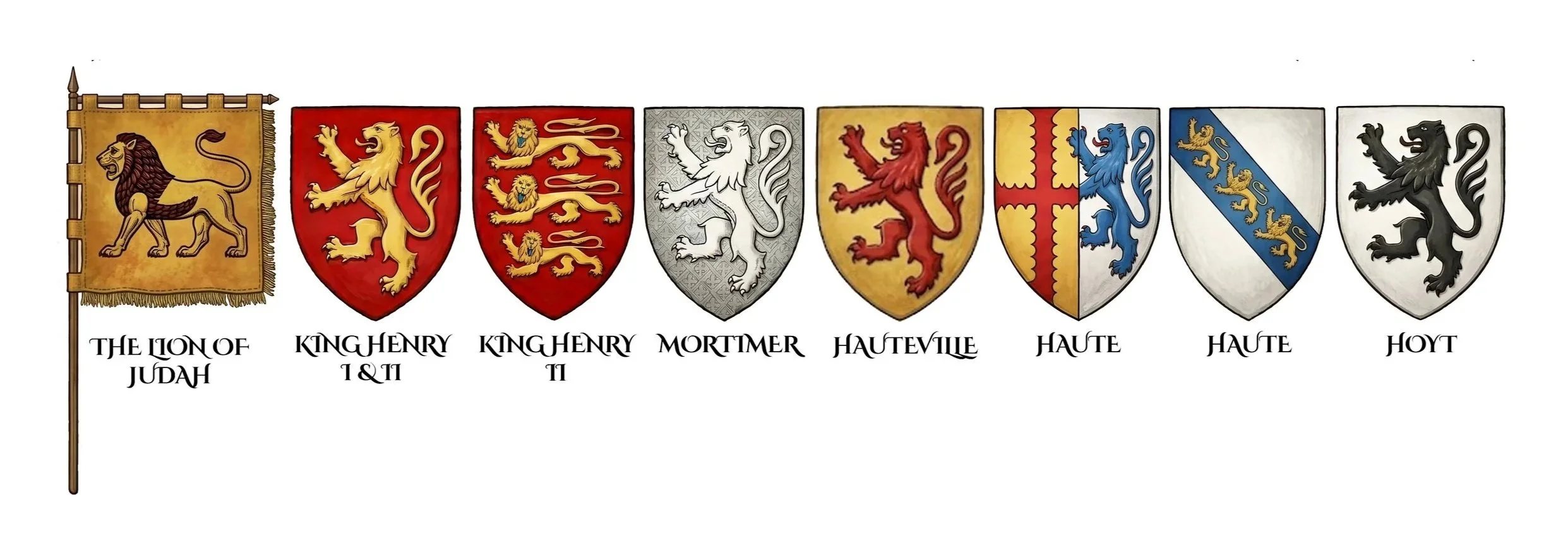
Genesis 49:9-10 Judah is a lion's whelp: From the prey, my son, thou art gone up: He stooped down, he couched as a lion, And as an old lion; who shall rouse him up? The sceptre shall not depart from Judah, Nor a lawgiver from between his feet, Until Shiloh come; And unto him shall the gathering of the people be. Numbers 2:2 Everyone of the children of Israel shall camp by his own standard, beside the emblems of his father’s house; they shall camp some distance from the tabernacle of meeting.
The bull, as an ancient symbol of potent life force and sacrificial power, was once offered in ritual as a manifestation of divine energy. Over time, this tradition evolved into the practice of the millers and the bread communion. The Haytes were also often millers; considered of the most trusted professions at the time. In this transformation, the raw vitality of the bull is allegorically transmuted through the art of milling—where grain is ground and refined into bread, the universal symbol of sustenance and spiritual nourishment harking from the time of Joseph’s Granaries and Tutmoses.
Carrying this ancient heritage across the Atlantic, the Simon Hayte branch emerged as the founders of Charlestown—the immortal “city on a hill”—thereby transplanting their symbolic and sacred lineage into the New World. "For we must consider that we shall be as a City upon a Hill. The eyes of the people are upon us. So that if we shall deal falsely with our God in this work we have undertaken, and so cause him to withdraw his present help from us, we shall be made a story and a byword throughout the world," a prolific quote from John Winthrop at the cornerstone of our republic. Along with Matthew 5:14 “You are the light of the world. A city set on a hill cannot be hidden… Let your light so shine before men, that they may see your good works and glorify your Father in heaven.”
Yet, beyond their practical roles, the Hoyt name has always been layered with entendre. Sometimes associated with a stick or branch serving as a multifaceted emblem: it is the branch of the ancient Judeo-Christian tribe from Jerusalem, the shepherd’s staff, the ecclesiastical rod, the mace scepter, the Egyptian regular or rule, and like a reign stick or talking stick the symbol of the jester’s sacred license to speak truth to power. This same imagery is echoed in the celebrated “spear-shake” allegory of Shakespeare, a nod to the freedom of speech and expression that the satirist is permitted in royal courts. In ancient England spears could only be carried by a freeman. The spear or rod vindicta was wielded by Athena and Libertas, alluding to wisdom as the upward route to freedom between earth and heaven.
In holding with the sacred tapestry of esoteric tradition, the rights of nations to claim the Arc of the Covenant and wield the Staff of Ptah are seen as a celestial charter—binding the stewardship of divine mysteries with the governance of earthly realms. A hoy is also a ship or arc; an allegory for the keystone hoist, governmental town-ship, and therefore the church hoit toit (the roofs of some churches are sometimes made from the keel of a ship).
Central to this esoteric heritage stands the TAU cross, the oldest form of the cross, shaped like the letter T. It is thought that this symbol originated among the Egyptians from the spread of a bull’s horns combined with the vertical line of its face. Revered in Druidism, Masonry, Mithraism, and the Egyptian Mysteries, the TAU/TOV/THOTH was fashioned from oak by the Druids in honor of Hu Gadarn, the solar lawgiver. Masonic lore further recounts that Tubal-cain’s hammer—bestowed upon Hiram Abiff—was a TAU, while in Kabbalah it appears as the TAV, emblematic of cosmic order. The Pythagoreans saw in it echoes of the tetractys, the divine triangle of creation. “The Hammer” also resonates from the nickname of Charles Martel and the modern-day gavel. The Hoyt name carries the legacy of the archetype with the intrinsic freedom to speak truth.
The quest of explorers like John Cabot, who sought a route to gold only to discover pyrite or “fool’s” gold, becomes an allegory for how Europe’s dismissive valuation of the New World paved the way for a bold experiment in freedom—a New England where many initiates had renounced the old ways and underwent a “philosophic death” in the manner attributed to Sir Francis Bacon. Bacon’s cryptic writings and his symbolic “spear-shake” revealed a divine fire intended not for kings, but for the liberated spirit.
To be a member of Hoyt family name is thus to inherit a multifaceted spiritual legacy that fuses the sacred authority of the staff, legendary wit, and the profound mysteries of light, sacrifice, liberty, and rebirth. This enduring testament to their heritage transcends time and tradition, uniting ancient esoteric wisdom with the founding ideals of a new world.
As devout Puritans, they sought religious freedom and embarked on the Puritan exodus to the New England colony in America. The American patriarch Simon “Goodman” Hayte, bearing the modified surname "Hait/Hayte," became a prominent figure in the New England colony. His unwavering dedication to constitutional values shared with Thomas Hooker laid the foundation for the Fundamental Orders, precursing the American Constitution. The Hayte (Hoyt) family's commitment to liberty, democracy, and religious freedom profoundly influenced the shaping of the United States.


As the Hayte family settled in the New England colony, their name gradually underwent further transformations. The phonetic shifts in the American and English languages played a significant role in this evolution. While maintaining the "Hayte/Hait/Haight" spelling for some time, the pronunciation slowly shifted to a sound closer to "Hoyt." This shift can be attributed to the American/English vowel shift, which incorporated elements from the original French "au/o” sound in "haute" while introducing the "ay" sound found in "hayte." The “ay/ai” sound is also attributed to the Anglian-West Saxon word “heh/heigh” meaning “height.” It is worth noting that another Hoyt family, with different Germanic English origins, settled in Salisbury, Massachusetts, during the same period. Though unrelated to the Kentish lineage, the convergence of the nomenclature further contributed to the establishment of the modern American surname "Hoyt." The Hoyte family in England also embraced the modern spelling, solidifying the evolution of the name across different branches of the family. It resonates with, “a Hoy there, maitee!” — a phrase of unity and companionship.


The saga of the Hoyt/Hayte, De Haute, and Hauteville family is one of a remarkable lineage that traversed continents and centuries, leaving an indelible mark on European and American history. From their noble origins and their pivotal role in the Crusades to their promotion of Christianity in England and participation in the Puritan exodus, their heritage exemplifies the spirit of adventure, religious devotion, and the pursuit of freedom. Their contributions continue to resonate through time, reminding us of the enduring legacy of this illustrious family throughout history.
https://surnamedb.com/Surname/hoyt
https://www.houseofnames.com/hoyt-family-crest
https://www.british-history.ac.uk/survey-kent/vol9/pp328-337
https://kentarchaeology.squarespace.com/journal/135/historical-research-notes
https://en.wikipedia.org/wiki/Tancred_of_Hauteville
https://www.youtube.com/watch?v=aqsnNUlx1gc
https://en.wikipedia.org/wiki/Robert_Guiscard
https://en.m.wikipedia.org/wiki/Gerard,_Duke_of_Lorraine
https://freepages.rootsweb.com/~fesschequy/genealogy/Hoyt.html
https://en.wikipedia.org/wiki/Roger_I_of_Sicily
https://www.genealogieonline.nl/fr/stamboom-oversluizen/I10336.php
https://www.wisconsinhistory.org/Records/Article/CS8875
https://archive.org/details/visitationofkent00camd/page/212/mode/2up
https://www.kentarchaeology.org.uk/Research/Libr/Wills/Bk47+48/page%20080.htm
https://www.cia.gov/library/abbottabad-compound/E4/E4AAFF6DAF6863F459A8B4E52DFB9FF4_Manly.P.Hall_The.Secret.Teachings.of.All.Ages.pdf —> https://archive.org/details/TheSecretTeachingsOfAllAgesManlyHall
https://en.wikipedia.org/wiki/Thoth
https://en.wikipedia.org/wiki/Hiram_Abiff
https://en.m.wikipedia.org/wiki/Weapons_and_armour_in_Anglo-Saxon_England
https://en.wikipedia.org/wiki/Libertas
https://en.wikipedia.org/wiki/Athena
https://en.wikipedia.org/wiki/William_Hawte
https://en.wikipedia.org/wiki/William_Haute_(MP)
https://en.wikipedia.org/wiki/Nicholas_Haute
https://sirthomaswyatt.com/2010/07/23/the-wyatts-in-jamestown/
https://minerdescent.com/2010/10/27/simon-hoyt/